

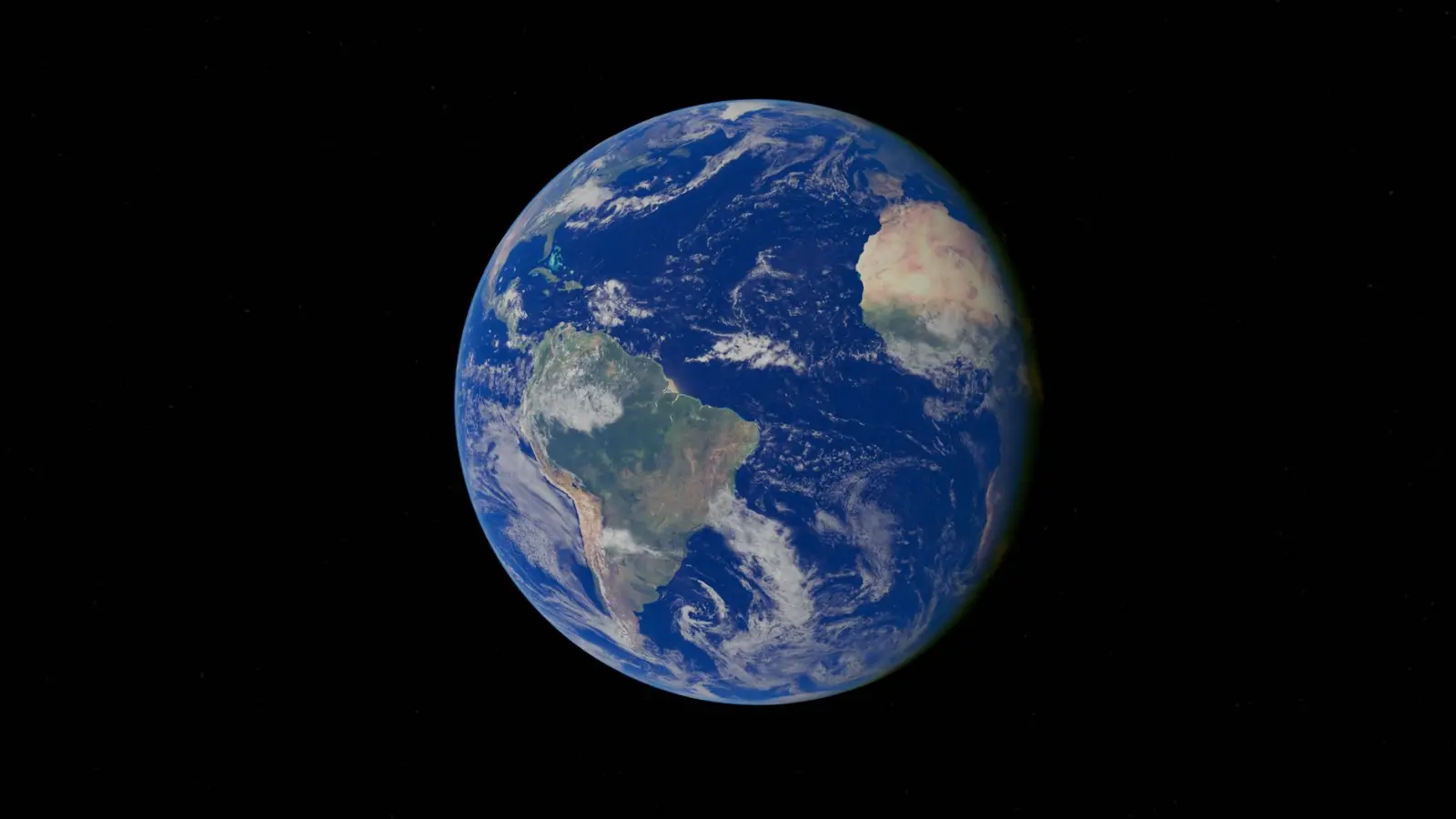
The question of what would happen if Earth stopped rotating tends to trigger two very different responses. One camp imagines dramatic, apocalyptic scenarios. The other dismisses it as physically impossible and moves on. The truth sits somewhere in between – not because the scenario is realistic, but because understanding what would actually unfold reveals something important about how our planet works.
I’ve spent enough time thinking through planetary mechanics to know that the immediate instinct to say “it can’t happen” is correct, but incomplete. Yes, the angular momentum involved is staggering. Yes, there’s no known mechanism that could halt rotation in any timeframe relevant to human civilization. But if we’re asking what the consequences would be, we need to separate the physics from the speculation and trace through what would actually happen in the hours and days that followed.
The first thing to understand is that Earth’s rotation isn’t some external force we feel pushing us around. It’s the baseline condition of everything on this planet. We’re not being held down by rotation – we’re moving with it. The moment rotation stopped, that baseline would vanish, and the consequences would ripple outward in ways that touch nearly every system at once.
The Immediate Atmospheric Catastrophe
The atmosphere doesn’t rotate because of some magnetic tether or invisible connection to the ground. It rotates because the air at the surface is in constant contact with the rotating planet, and friction keeps it moving along. The moment Earth stopped, the atmosphere would not. It would continue moving at roughly 1,000 miles per hour at the equator – the speed Earth’s surface is currently moving – and everything in that air would slam into the stationary ground.
This is the part most people get wrong. They imagine a gentle slowdown. In reality, you’re talking about hurricane-force winds everywhere, simultaneously, with no transition period. These aren’t ordinary hurricanes. A hurricane’s wind speed is measured in the hundreds of miles per hour and covers a region. This would be a planetary-scale phenomenon with winds exceeding 1,000 mph across the entire equatorial band, gradually decreasing toward the poles.
The kinetic energy in that moving atmosphere has to go somewhere. It would be converted into heat through friction. Forests would ignite. Structures would be obliterated. The friction between air and ground would generate temperatures that would make the immediate surface uninhabitable. This phase would last hours, not days. By the time the atmosphere came to rest relative to the ground, the damage would be almost incomprehensible.
What Happens to the Oceans
Water behaves similarly to air, but with one crucial difference: it’s much denser and carries far more energy. The oceans are rotating at the same speed as the ground, held in place by friction and gravity. If Earth stopped, the water would keep moving.
The result would be a series of tsunamis that make historical events look like ripples. At the equator, where rotational velocity is highest, the water would be moving at over 1,000 mph relative to the newly stationary ground. Waves of unimaginable scale would propagate toward the poles, carrying the kinetic energy of the entire ocean. Coastal regions would be completely submerged. Inland flooding would extend hundreds of miles. The sheer volume of water in motion would reshape continents.
But there’s a secondary effect that’s equally important. Earth’s rotation has been shaping ocean circulation patterns for millennia. The Coriolis effect – which exists because of rotation – drives the major currents that distribute heat around the planet. Stop the rotation, and those currents would collapse. The thermal structure of the oceans would begin to reorganize, but not before the kinetic energy from the initial motion had already done its damage.
The Crust and Mantle Response
This is where the scenario becomes genuinely interesting from a geological perspective. Earth’s crust and mantle aren’t rigidly locked to the rotation. They rotate with it, but they have inertia of their own. If the rotation stopped instantaneously – which is the only way to think about this hypothetically – the crust would experience enormous stress.
The planet’s shape itself is affected by rotation. Earth bulges slightly at the equator because of centrifugal effects. The moment rotation stopped, that bulge would begin to relax. The redistribution of mass would trigger earthquakes on a scale that has no historical precedent. Fault lines everywhere would rupture. Volcanic activity would spike as the stress on the mantle changed. The solid Earth would be in motion for weeks or months as it adjusted to its new shape.
The lithosphere would crack and shift. Mountain ranges might collapse. Ocean basins would deform. This isn’t a localized event – it would be a global reorganization of the crust. The energy released would dwarf the energy from the atmospheric and oceanic motion, and it would persist long after those initial catastrophes had run their course.
The Day-Night Cycle Vanishes
Once the rotation actually stopped, one hemisphere would be locked in permanent daylight and the other in permanent darkness. The terminator line – the boundary between day and night – would become fixed. One side of the planet would experience continuous solar heating. The other would radiate heat into space with no incoming solar energy.
The sunlit side would heat up dramatically. Without rotation to distribute that heat, temperatures would climb far beyond what any terrestrial ecosystem could tolerate. The dark side would cool rapidly, potentially reaching temperatures where carbon dioxide would begin to condense out of the atmosphere. The temperature gradient between the two hemispheres would be the steepest in Earth’s history.
This thermal imbalance would drive atmospheric circulation patterns unlike anything we’ve ever seen. The air would try to flow from the hot side to the cold side, but the lack of Coriolis effect would change how that flow organized. You’d get massive convection cells spanning from equator to pole on each hemisphere, with wind speeds that would persist for years as the system tried to reach equilibrium.
Why This Matters More Than It Seems
The reason I find this scenario worth thinking through isn’t because it might happen. It won’t. The reason is that it illuminates how dependent everything on this planet is on a single, continuous motion that we barely notice. We don’t feel the rotation. We don’t think about it. But nearly every major system – weather, ocean currents, the shape of the planet itself, the distribution of heat, the stability of the crust – depends on it.
When you trace through what would happen step by step, you start to understand why Earth’s rotation isn’t just a detail. It’s foundational. The atmosphere, the oceans, the crust, the magnetic field, life itself – all of it evolved under the condition of continuous rotation. Remove that condition, and you don’t get a slower version of Earth. You get something unrecognizable.
The scenario also reveals something about how we think about planetary systems. We tend to imagine catastrophes as sudden events – an asteroid impact, a supervolcano. But the most consequential changes are often the ones that affect the baseline conditions. A planet that stops rotating isn’t experiencing a disaster on top of normal conditions. It’s experiencing the loss of the condition that makes normal possible.