

After spending time observing octopuses in controlled environments and in the field, you begin to notice something that separates them from most other marine animals. They don’t just react to their surroundings – they seem to evaluate them. An octopus will approach a novel object with deliberation, test it with different arms, and adjust its strategy based on what it learns. This isn’t scripted behavior. It’s reasoning happening in real time.
What makes octopuses genuinely remarkable isn’t a single trait but rather the combination of flexibility, curiosity, and problem-solving ability they bring to situations they’ve never encountered before. They solve puzzles they haven’t been trained on. They use tools. They recognize individual humans. They escape from enclosures by unscrewing jar lids from the inside. These aren’t isolated incidents – they’re consistent patterns that appear across different species and individuals.
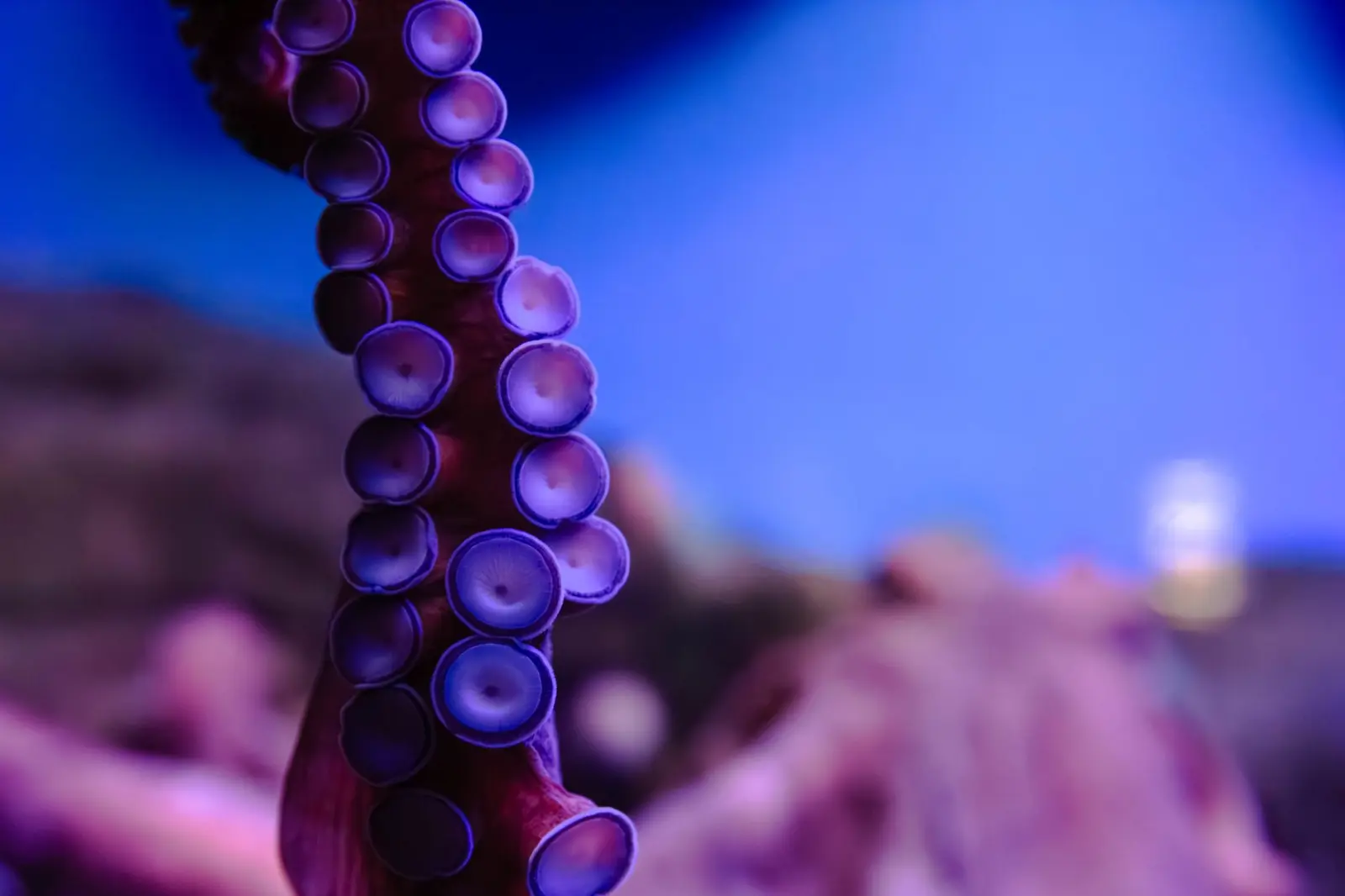
The common assumption is that intelligence requires a centralized brain like ours. Octopuses demolish that assumption. Two-thirds of their neurons live in their arms, not in their central brain. This distributed nervous system means each arm can process information and act semi-independently while still coordinating with the others. An octopus arm can taste, touch, and manipulate an object while the central brain handles broader strategy. This architecture allows them to multitask in ways that would be impossible for animals with more conventional nervous systems.
How Their Nervous System Enables Flexibility
The distributed neural architecture isn’t just different – it’s genuinely alien compared to vertebrate cognition. When an octopus encounters a crab in a crevice, its arm doesn’t need to wait for the brain to send detailed instructions. The arm explores the space, feels the texture of the rock, and adjusts its grip and angle based on local sensory feedback. Meanwhile, the central brain can monitor the overall situation, watch for threats, and plan the next move. This parallel processing gives octopuses an adaptive edge in unpredictable environments.
I’ve watched octopuses solve problems that required them to suppress their immediate instinct. A hungry octopus faced with food behind a barrier doesn’t just attack the barrier repeatedly. It pauses, explores alternative approaches, and sometimes finds a way around rather than through. This impulse control, combined with their ability to learn from a single observation, suggests something closer to genuine reasoning than simple trial-and-error.
Recognition and Social Awareness
Octopuses recognize individual humans. Not as a species, but as distinct individuals. In lab settings, an octopus will treat a researcher who has fed it differently from one who has only observed it. They show preference, anticipation, and something that resembles memory of past interactions. Some individuals become curious and interactive; others remain wary. This variation in personality and social response is harder to explain through instinct alone.
They also demonstrate what looks like play behavior. Young octopuses will interact with objects they don’t need to eat, manipulating them in ways that serve no obvious survival function. They’ll juggle shells, push objects around, and seem to enjoy the activity. Whether this constitutes true play in the way mammals experience it remains debated, but the behavior suggests something beyond pure feeding and mating drives.
Tool Use and Problem-Solving Under Pressure
Tool use appears in some octopus species. They carry coconut shells and clam shells, assembling them into protective shelters. They’ve been observed using rocks to block den entrances. These aren’t one-off accidents – they’re deliberate, repeatable behaviors that show planning and foresight. An octopus gathers materials before it needs them, suggesting it can mentally model a future scenario and prepare accordingly.
What’s particularly telling is how they solve novel problems. When presented with a sealed container holding food, octopuses don’t just apply a memorized solution. They experiment. They try different approaches, learn which ones fail, and adjust. Some individuals solve the problem faster than others, suggesting individual variation in problem-solving ability – another marker of genuine intelligence rather than fixed behavioral patterns.
In the wild, octopuses hunt in ways that demand real-time decision-making. They stalk prey, adjust their approach based on the prey’s behavior, and use camouflage not just as passive concealment but as an active hunting tool. They change color and texture to match their surroundings while simultaneously searching for food. This requires integrating sensory information, predicting prey behavior, and executing a coordinated physical response – all under the pressure of finding enough calories to survive.
The Limits of Comparison
Measuring octopus intelligence against human or primate standards misses the point. Their intelligence is specialized for their ecological niche. They’re solitary, short-lived animals without complex social structures. They don’t need the kind of social reasoning that primates develop. But in domains that matter to them – spatial reasoning, problem-solving, learning from observation, and adapting to novel situations – they perform at levels that demand respect.
The real insight isn’t that octopuses are “almost as smart as dolphins” or some other comparative ranking. It’s that intelligence can take radically different forms. A distributed nervous system, a short lifespan, and a solitary lifestyle produce a type of cognition that’s genuinely different from what we see in mammals or birds. Octopuses aren’t trying to be like us. They’re solving problems in ways their biology and environment have shaped them to solve.
Working with these animals reveals something humbling: we’re still developing the vocabulary and frameworks to even describe what they’re doing. When an octopus solves a problem we’ve designed, it’s not following a script we’ve written. It’s thinking. The mechanisms may be unfamiliar, the architecture may be strange, but the outcome – adaptive, flexible behavior in response to novel challenges – is unmistakably what we’d call intelligence.