Deaf/hearing impaired TV, DVD, Cinema & the Arts news

UK regulator seeks to improve live TV captioning

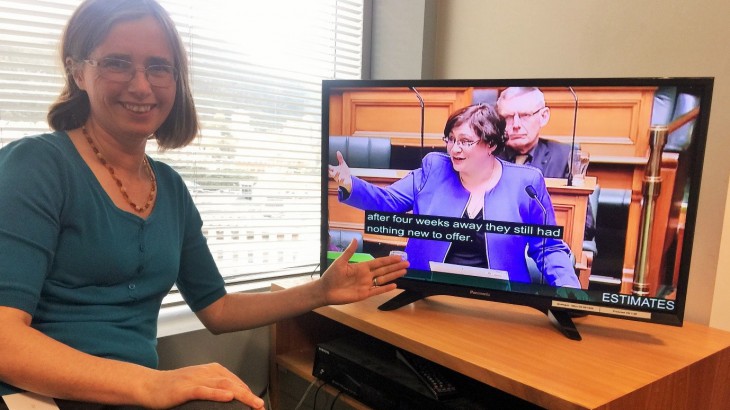
The UK communications regulator Ofcom has announced proposals aimed at improving the quality of live captioning on television, including asking broadcasters to report on the quality of their captions.

Ofcom notes that the quality of pre-prepared captions (which are called ‘subtitles’ in the UK) is generally very good, and the majority of complaints it receives are related to live captioning. As caption quotas have risen, so have the number of programs being captioned live. Most of this captioning is now undertaken using speech recognition technology, but this is imperfect and errors are common. 

Following consultation with viewers and representative groups, Ofcom has concluded that the four key dimensions that affect the quality of live captions are:


Top of page

Captioned cinema moves forward with new technologies

Two new accessible cinema developments in the USA and UK have movie fans getting excited about what might be the next steps in captioned movies. Both developments, InvisibleCaptions and the Off-Screen Cinema Subtitle System, present the compromise that can win over both consumers and exhibitors.

That compromise is one that allows exhibitors to screen captioned movies across a wide range of sessions where the captions are seemingly ‘open’ to those that are wearing filtering glasses, very similar to 3D glasses. The glasses do not carry projection equipment making them lightweight and less bulky than current captioned cinema eyewear such as Sony’s.


Top of page

The 2013 Print Disability Roundtable

The Roundtable on Information Access for People with Print Disabilities is a forum of 40 organisations from Australia and New Zealand. Its upcoming conference will bring together influential thinkers in web accessibility, braille and audio description.

Someone with a print disability is defined as a person without sight, a person whose sight is severely impaired, a person unable to hold or manipulate books or to focus or move his or her eyes, or a person with a perceptual disability, such as dyslexia.

Organisations with speakers at the conference include Vision Australia, the Australian law Reform Commission, Royal New Zealand Foundation of the Blind. Media Access Australia has two speakers: CEO, Alex Varley, and project manager, Dr Scott Hollier.


Top of page

Ai-Media appoints new caption quality auditor

The access provider Ai-Media has appointed Robert Scott as an independent auditor to ensure the quality of the captions it produces for broadcast, government, education and corporate services in Australia and the UK.

Scott has had a long career in access. He was formerly CEO of the Australian Caption Centre (the not-for-profit organisation from which Media Access Australia grew), and has a long-standing commitment to captions being of the highest possible quality.


Top of page

Disability: the untold story of the NBN

We sat down with Graeme Innes, Disability Discrimination Commissioner and National Broadband Network Champion, to talk about how high-speed internet can benefit people with disability. Interview by Eliza Cussen.

GI: I’m one of a group of champions in a whole range of areas as to how the NBN is relevant to Australian society. I wasn’t in the original group and I kept going back to the minister, Stephen Conroy, and saying “Look, disability is the untold story of the NBN. I think you should have someone telling these stories.” He came back to me and said, “That’s great, will you do it?”


Top of page

Deaf advocate takes discrimination claim to the United Nations

Michael Lockrey, a prominent figure in Australian disability advocacy, has petitioned the United Nations Committee on the Rights of Persons with Disabilities after he and the New South Wales Government failed to reach conciliation over a discrimination complaint.

In February 2012, Lockrey was summoned for jury service in Lismore Court in northern NSW. He wrote to the court and requested live captioning be provided for him during the trial. After much correspondence, Lockrey was informed that captions would not be provided and that he had been excused from jury service because he is Deaf.


Top of page

Accessible DVDs released in March 2013

At least 21 movies released on DVD in the last two months have been made accessible with closed captions and audio description. Of the 60 titles we researched, 45 were captioned (or 75 per cent) and 21 described and captioned (or 35 per cent).

Distributors 20th Century Fox, Accent, Eagle, Gryphon and Madman all had titles released internationally with either captions or subtitles that were not released in Region 4, a market which includes Australia, New Zealand, South America and Oceania.

Further still, both Disney and Icon released titles locally without audio description where this feature was available in international territories. Those movies were Now Is Good from Disney and Beasts of the Southern Wild from Icon.

The titles with both audio description and captions are:


Top of page

Captioning on digital multichannels

The Federal Government is due to introduce new regulations regarding captioning on digital multichannels like GO!, 7Two, Eleven and ABC2 which will take effect in 2014. With this in mind, Media Access Australia has conducted a survey of the content and current levels of captioning on these channels.

Under current provisions in the Broadcasting Services Act, the only programs which need to be captioned on multichannels are repeats which were originally shown with captions on a network’s primary channel. The survey shows that captioning on the commercial networks’ multichannels remains largely confined to repeats, with some exceptions such as Neighbours, which screens on Eleven, and AFL matches on 7Mate. Overall, the Seven Network’s multichannels, 7Two and 7Mate, had the highest levels of captioning, with over 40% of programs between 6am and midnight being captioned.


Top of page

Opinion: The scourge of YouTube’s auto-captions

Michael Lockrey is Asia-Pacific sales manager for Amara and a renowned advocate for Deaf and hearing impaired media access. Here, he dissects the effects of YouTube’s auto-captioning tool, and suggests how Google and its users can play a part in resolving them.

Google’s YouTube is the global giant of online video, with over 72 hours of video being uploaded to the platform every minute. But with popularity comes responsibility. While YouTube in many ways could be seen as a pioneer of Deaf access online, the premature release of its auto-captioning feature could be doing more harm than good.

The mantra “poor quality captions are as good as no captions at all” will be familiar to many of us within the Deaf and hearing loss advocacy sector. It’s a common catch-cry when dealing with traditional broadcasters.


Top of page

Report on the accessibility of Electronic Program Guides

Media Access Australia has released a report on electronic program guides (EPGs) and how television networks and content providers display access information such as closed captions (CC) or audio description (AD). The report has found there is inconsistency amongst broadcasters and content providers when it comes to displaying this information on electronic formats.

Report author Clarizza Fernandez said, "Australia is lagging behind its international counterparts like the UK and the US where there are clear guidelines for displaying 'CC' or 'AD' on EPGs.

"For the Deaf and hearing impaired, the blind and vision impaired, access information is essential and they should not be left out."


Top of page
Syndicate content